Chapter 07 · Watch, then practise
Deadlock
Watch the related lecture, then read the question and answer below.
10 questions · 7 playlist videos. Matches are based on video titles; broader background matches are labeled.
Open the full chapter playlist ↗5 Minutes Engineering · 6:33
Topic match: deadlock and its necessary conditions.
1. Deadlock and necessary conditions — 2070 Bhadra
Define deadlock and explain the conditions necessary for it to occur.
Answer
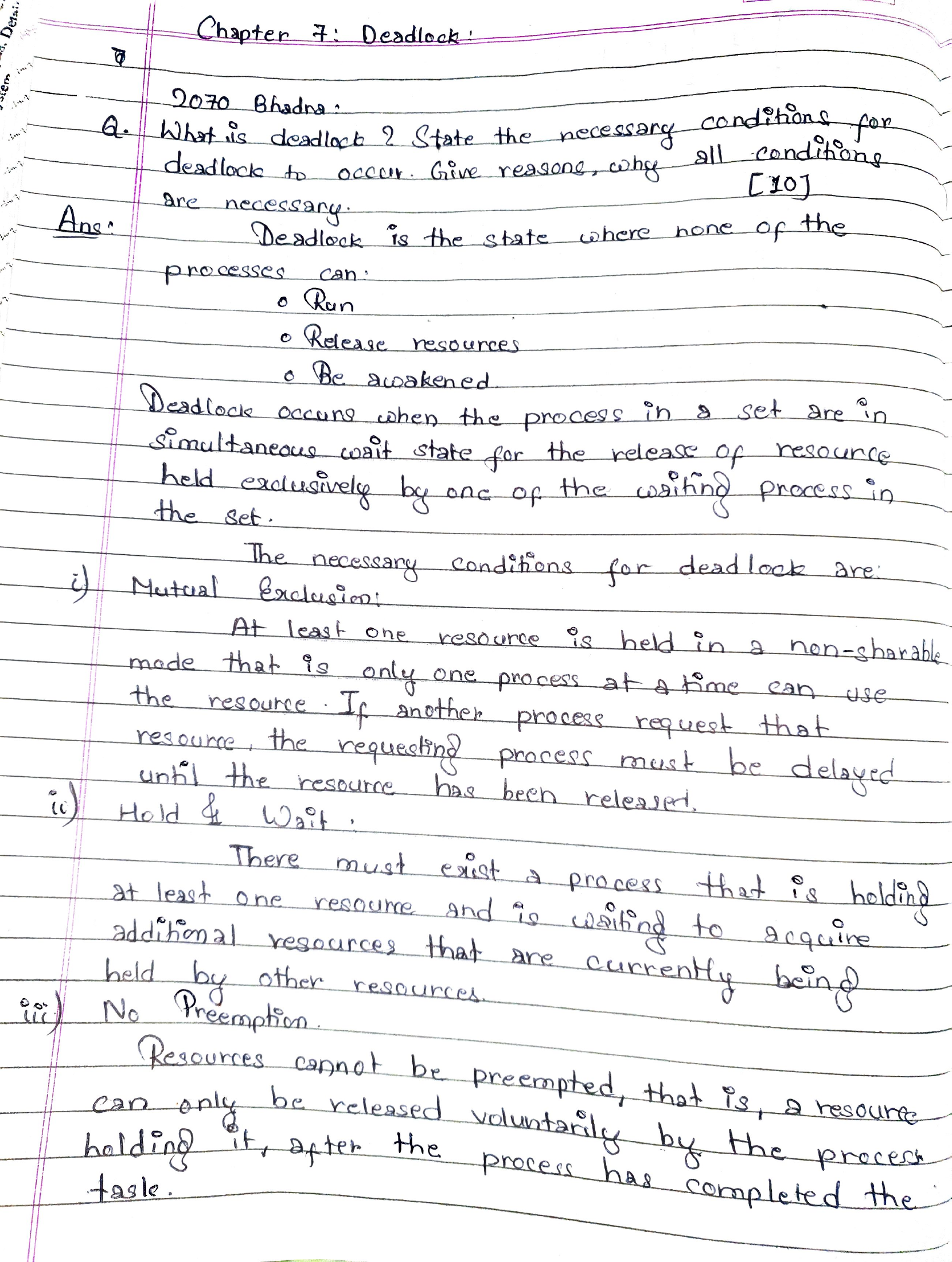
A set of processes is deadlocked when every process is waiting for an event or resource that only another process in the set can provide. None can proceed or release what the others require.
The source lists four necessary conditions:
- Mutual exclusion: A resource can be used by only one process at a time.
- Hold and wait: A process holds resources while waiting for additional resources.
- No preemption: A resource cannot be forcibly taken away from its owner.
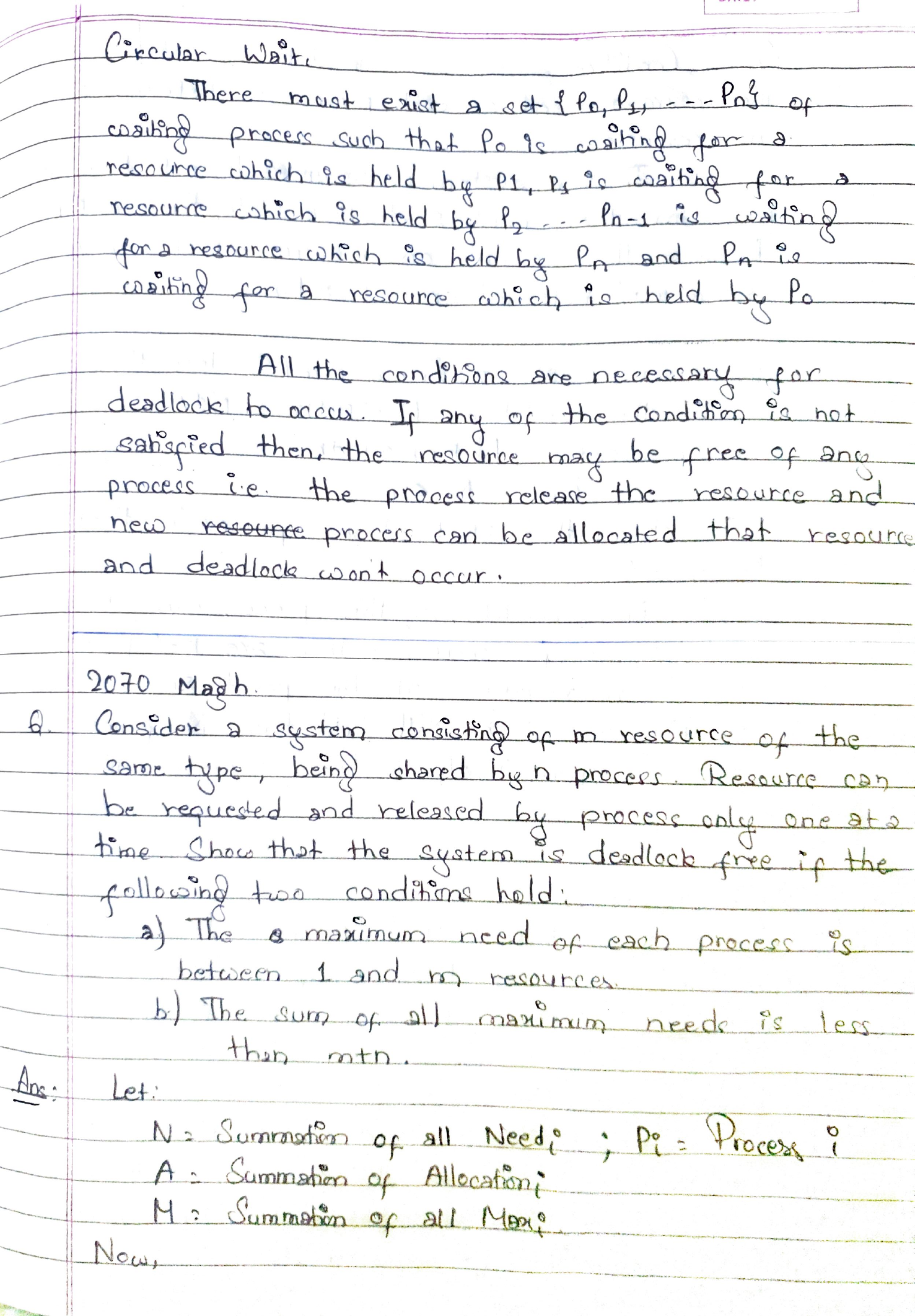
- Circular wait: There is a circular chain of processes, each waiting for a resource held by the next.
All four must hold for deadlock to occur; breaking a necessary condition prevents it. Original process notation and discussion:
5 Minutes Engineering · 6:33
Background on the necessary conditions for deadlock. The playlist has no video specifically identified as this resource-bound proof.
2. Resource-bound proof — 2070 Magh
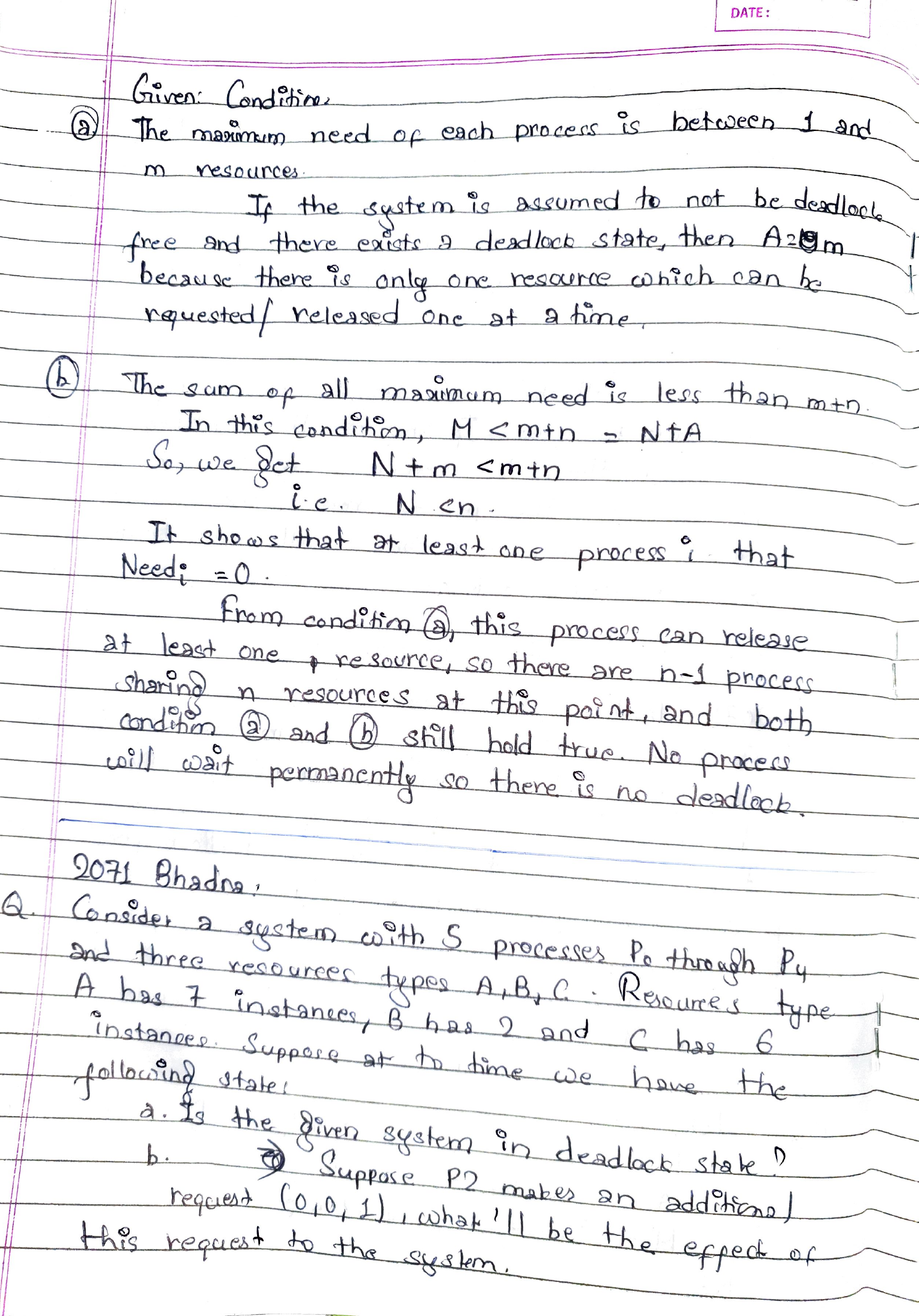
For m identical resources and n processes, each requesting one resource at a time, prove the no-deadlock result under the maximum-demand conditions stated in the source.
Answer
The question bounds each process's maximum need between 1 and m and gives an inequality involving the sum of maximum needs and m + n. The original statement and proof are reproduced as images so that all inequalities, summations, and handwritten steps remain unchanged.
The handwritten algebra is not independently validated. Read the original conditions and steps together; this conversion does not repair the proof.
TutorialsPoint · 5:56
5 Minutes Engineering · 10:01
5 Minutes Engineering · 7:20
Related tutorials on detection and Banker’s algorithm. They are not verified solutions to these matrices or the source’s inconsistent working.
3. Allocation state and an additional request — 2071 Bhadra
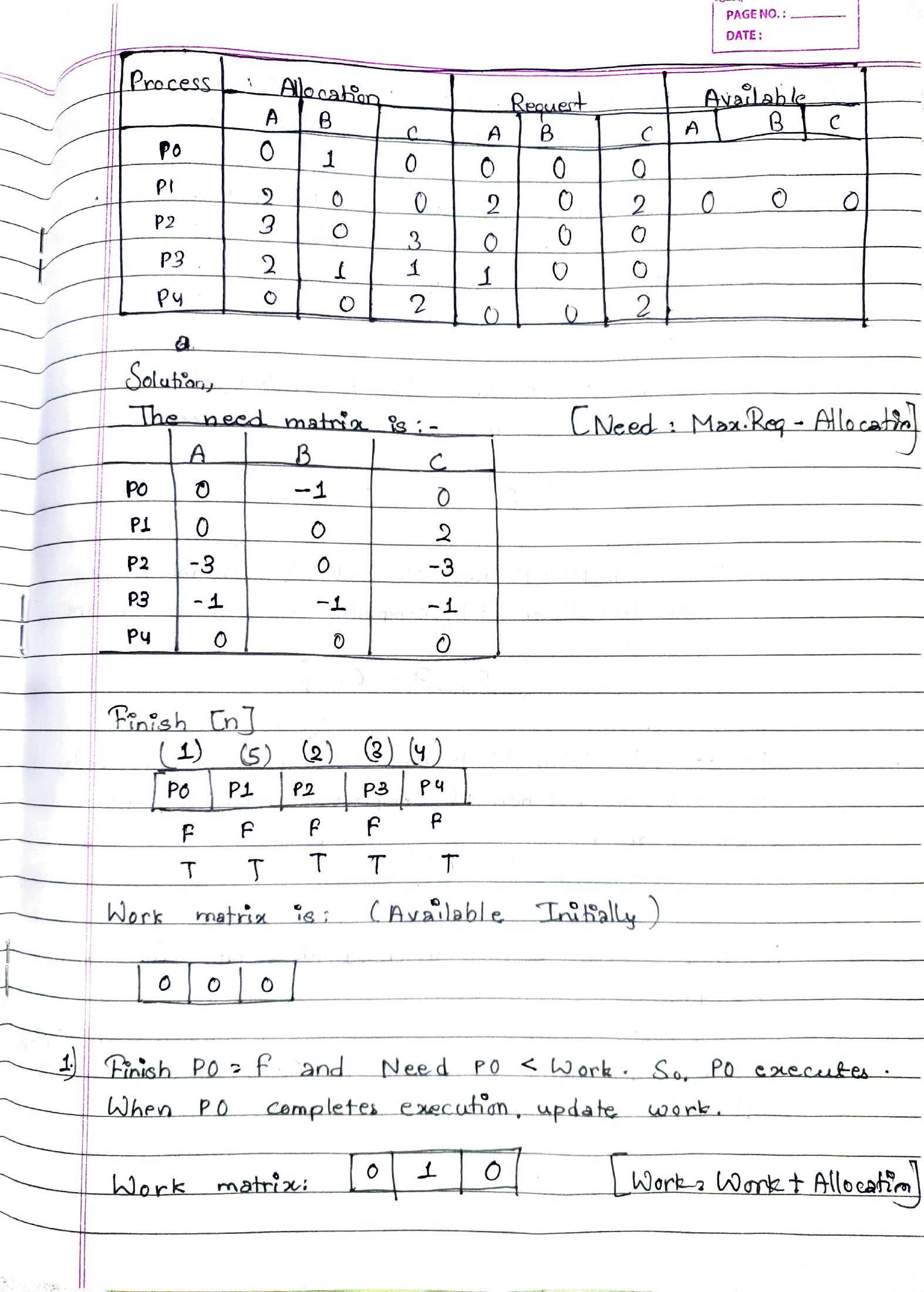
For five processes and resource totals A = 7, B = 2, C = 6, use the supplied allocation/request tables to determine whether the state is deadlocked and whether P2's additional request (0, 0, 1) can be granted.
Answer
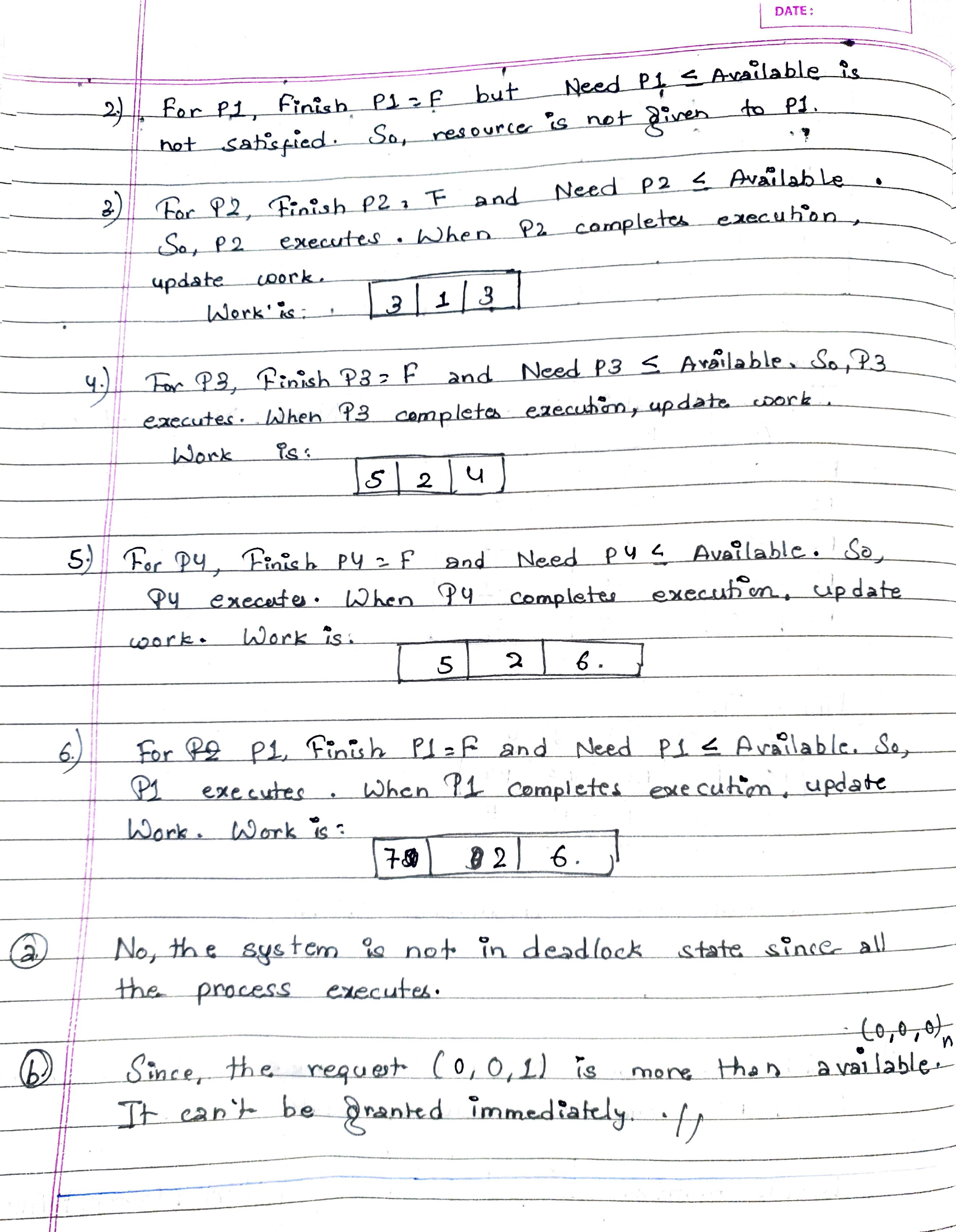
The source constructs allocation, request/need, and work tables. It claims the system is not deadlocked and gives the order P0, P2, P3, P4, P1. It rejects the additional request with an available vector of (0, 0, 0).
Source inconsistency: The working treats a request table as a maximum-demand table and contains negative need entries. The reported conclusion is retained for fidelity and is not a validated Banker/detection result.
The full original matrices and working follow:
5 Minutes Engineering · 6:33
TutorialsPoint · 5:56
Last moment tuitions · 5:27
Topic matches for deadlock conditions, detection, and recovery.
4. Conditions, detection, and recovery — 2071 Magh
State the necessary conditions for deadlock and explain detection and recovery.
Answer
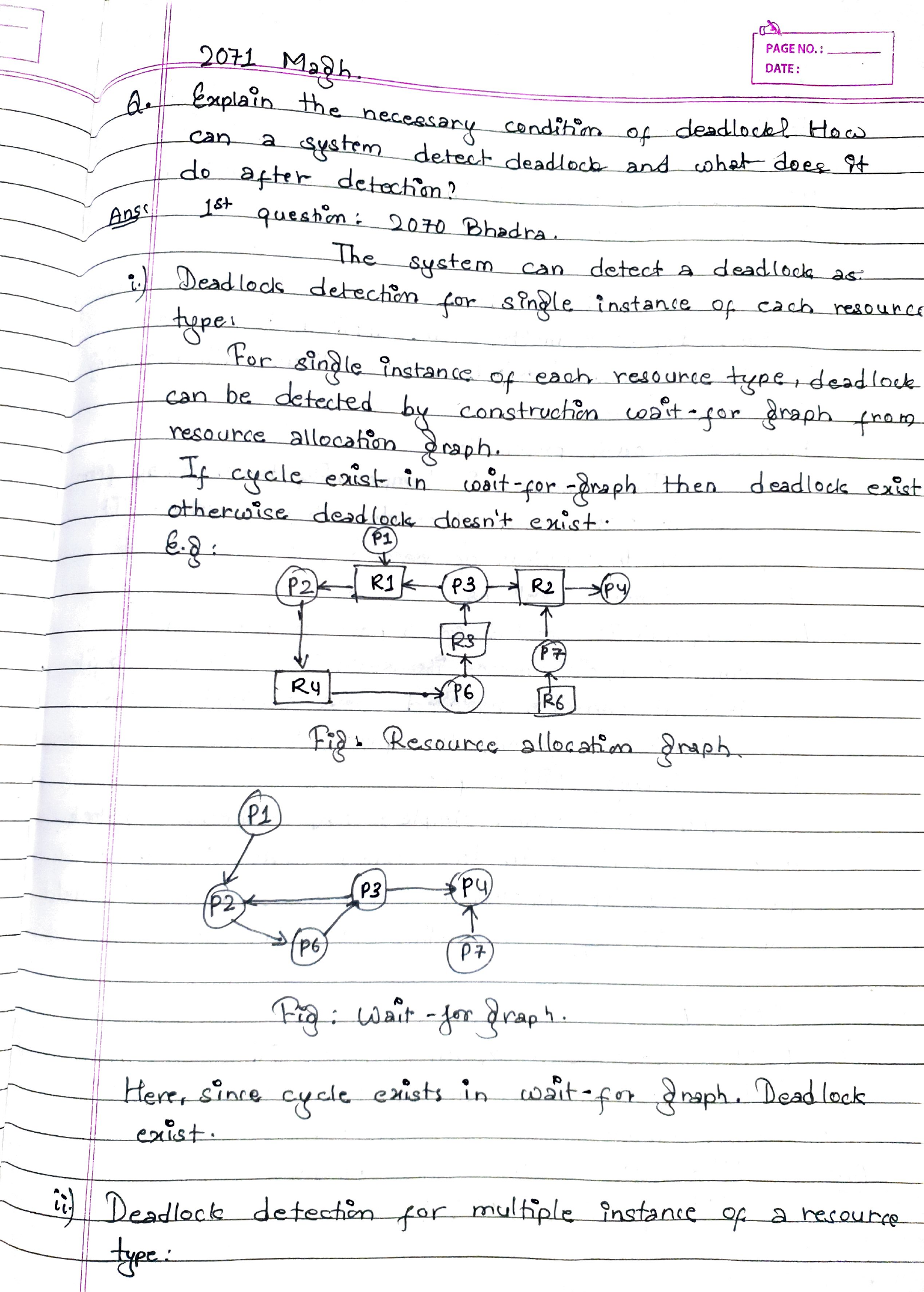
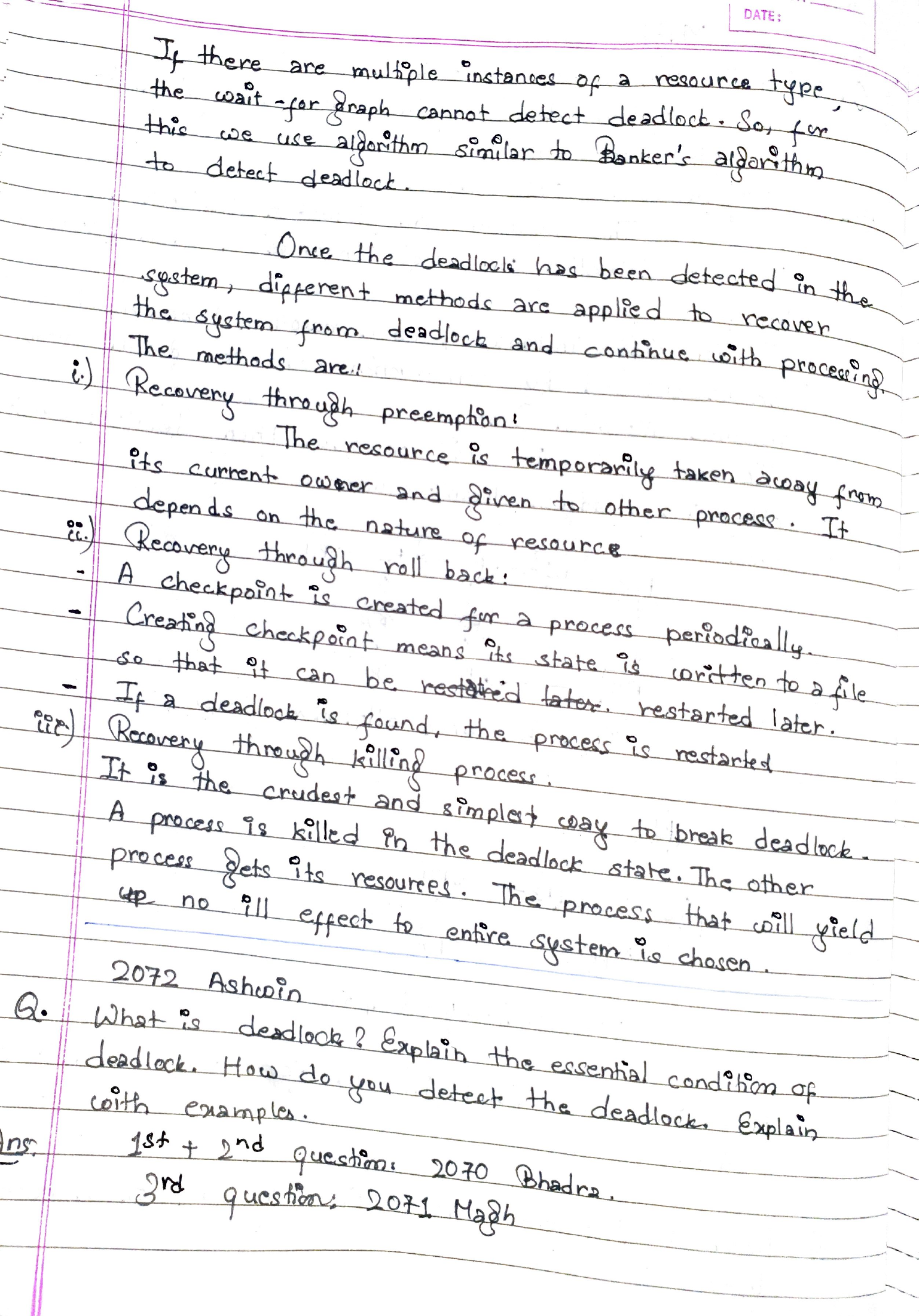
The four conditions are given in Question 1. With one instance of each resource type, a cycle in the wait-for graph identifies deadlock. For multiple instances, the source describes a matrix-based detection approach examining requests, allocations, and available resources.
Recovery approaches include:
- Preemption: Take a resource from a process when that resource supports it.
- Rollback: Restore a process to a saved checkpoint so resources can be released.
- Termination: Kill a process, choosing one whose termination has a comparatively small impact, to break the deadlock.
Original graphs and recovery discussion:
5 Minutes Engineering · 6:33
TutorialsPoint · 5:56
Topic matches for the definition, necessary conditions, and detection of deadlock.
5. Repeated definition and detection question — 2072 Ashwin
Define deadlock, state its necessary conditions, and explain detection with examples.
Answer
Cross-references the earlier definition/conditions and detection answers. See Question 1 and Question 4, including the original diagrams.
Last moment tuitions · 4:46
5 Minutes Engineering · 10:01
TutorialsPoint · 5:56
Topic matches for prevention, avoidance through Banker’s algorithm, and detection.
6. Avoidance, detection, and prevention — 2072 Magh
Explain deadlock avoidance, detection, and prevention.
Answer
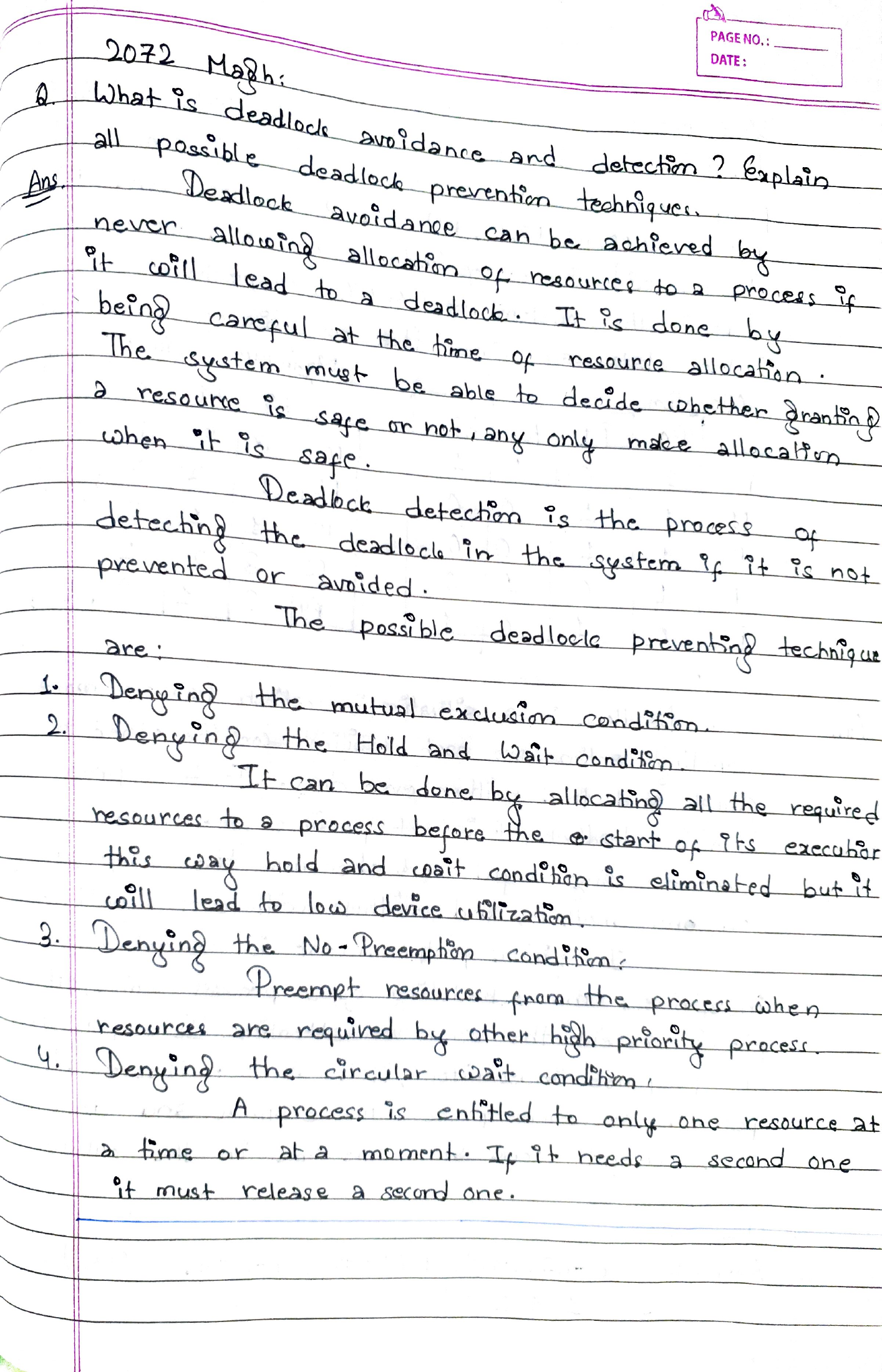
Avoidance checks a request before granting it and permits allocation only if the resulting state remains safe. Detection checks whether deadlock has occurred when it is not prevented in advance. Prevention denies at least one of the four necessary conditions.
The source discusses requiring a process to obtain all resources before starting, with the disadvantage of low utilization; preemption; and restricting resource acquisition to break circular waiting. Mutual exclusion appears as a listed condition without a separate prevention explanation.
The circular-wait paragraph contains a repeated resource label that makes its release rule unclear. Its wording is retained in the scan rather than silently corrected.
5 Minutes Engineering · 10:01
5 Minutes Engineering · 7:20
Partial match: safe-state calculations using Banker’s algorithm. The videos are not verified solutions to these matrices and do not specifically identify indefinite postponement.
7. Indefinite postponement and safe-state calculation — 2073 Bhadra
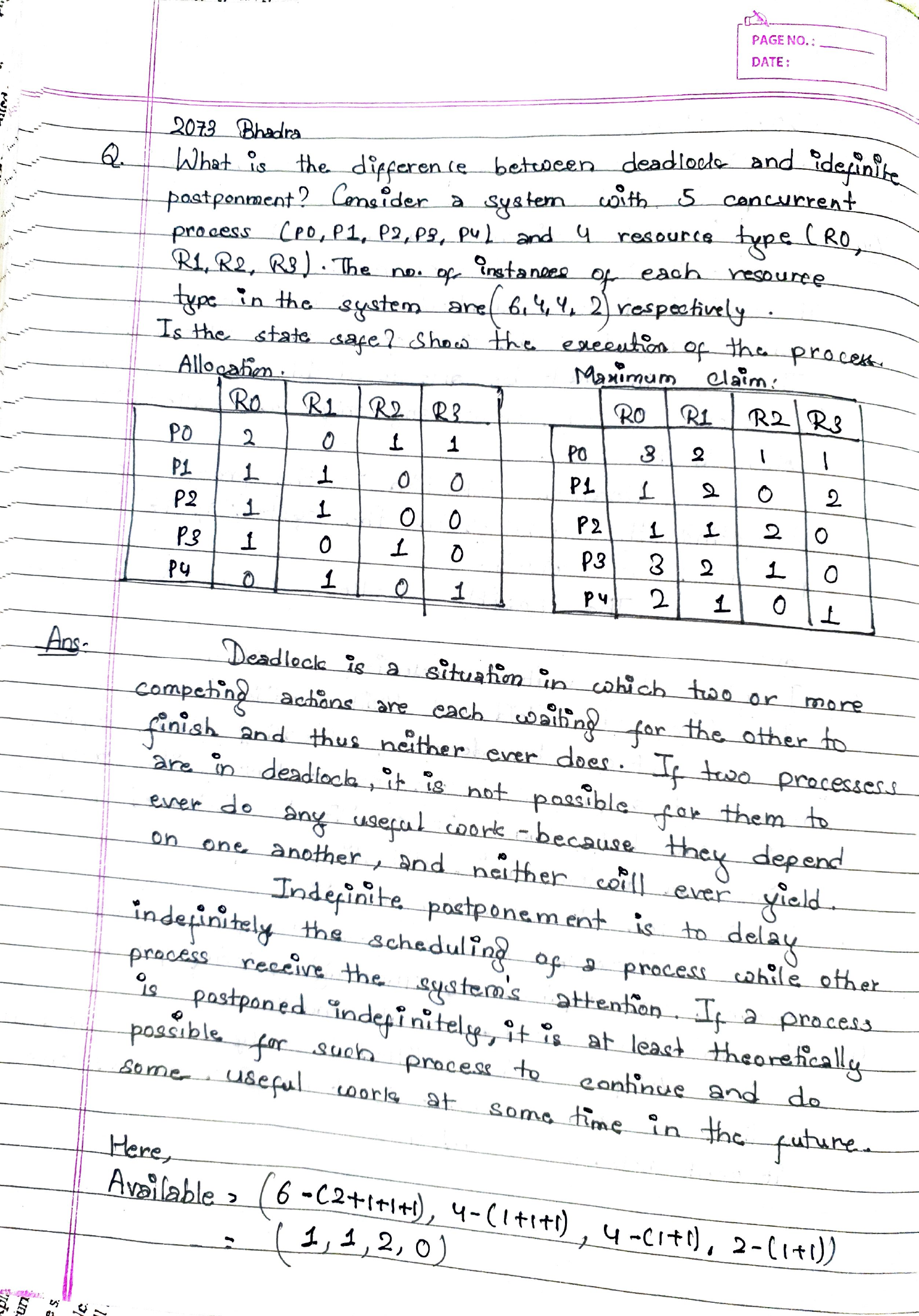
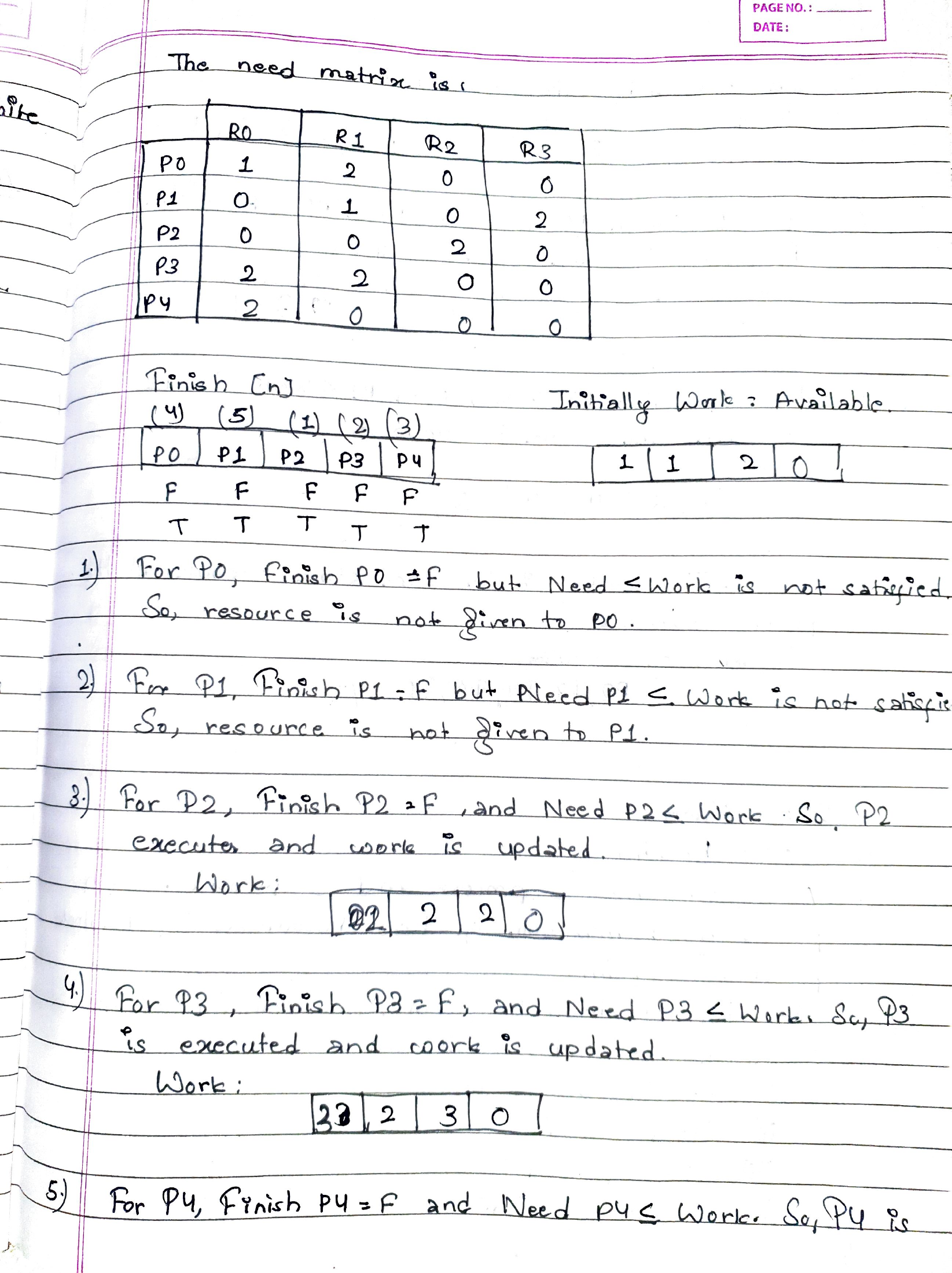
Differentiate deadlock from indefinite postponement. For five processes and four resource types with totals (6, 4, 4, 2), use the supplied allocation and maximum-demand matrices to examine safety.
Answer
In deadlock, processes cannot progress because each needs an event or resource another blocked process must provide. With indefinite postponement, a process could in principle run but is repeatedly delayed.
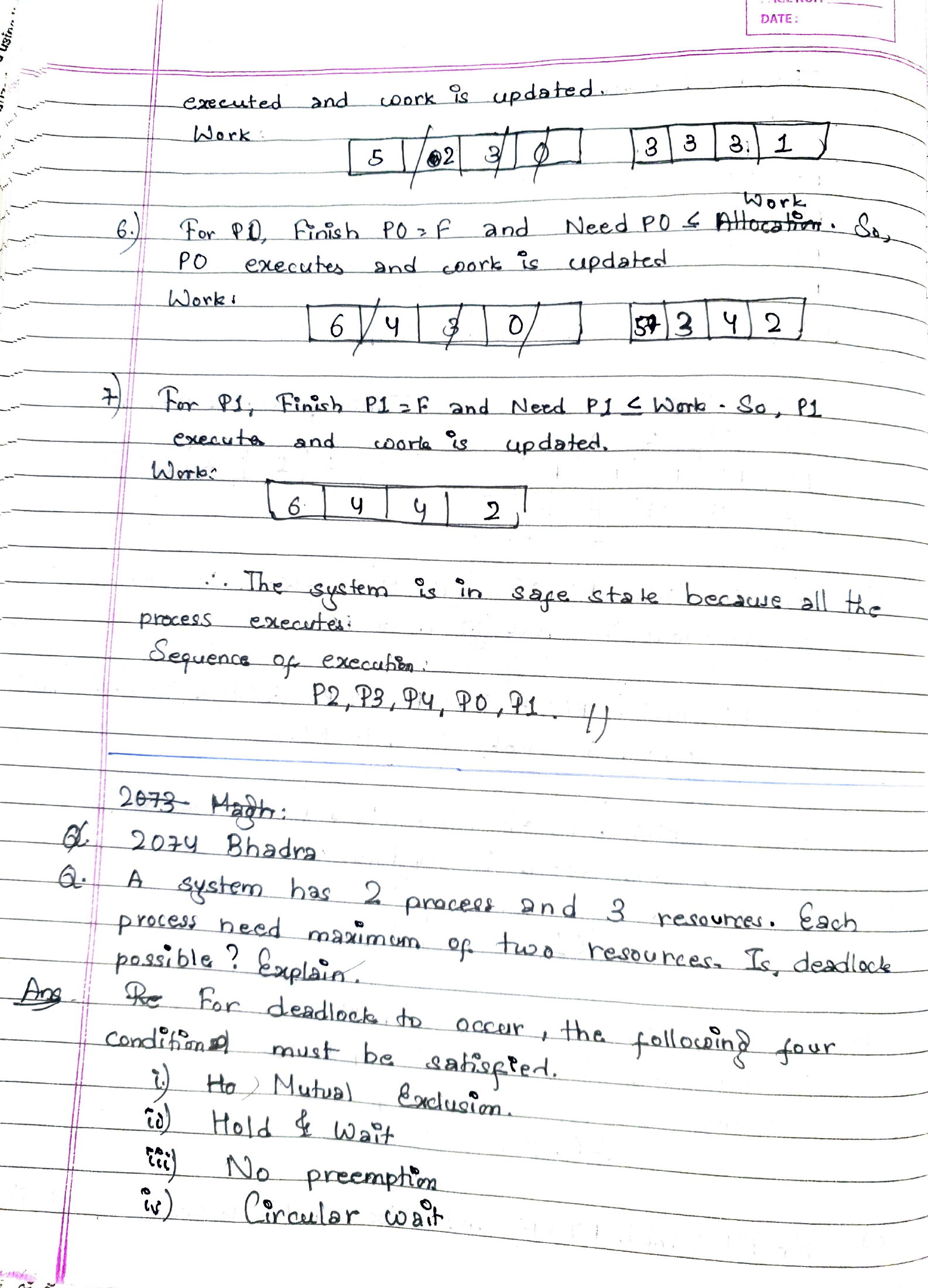
The source computes an available vector of (1, 1, 2, 0) and gives the safe sequence P2, P3, P4, P0, P1. The original matrices, need calculations, and work-vector updates are retained below without substituting a new calculation:
No video is assigned because the source provides an exam heading without a separate question statement.
8. Source heading — 2073 Magh
A separate question statement is not available for this exam heading.
Answer
This exam heading appears without a separate complete question and answer. The preceding worked safety example is retained in Question 7; no new problem has been invented for this heading.
5 Minutes Engineering · 6:33
5 Minutes Engineering · 10:01
Related background on deadlock conditions and safe allocation. These videos are not verified solutions to this exact two-process example.
9. Two processes and three resources — 2074 Bhadra
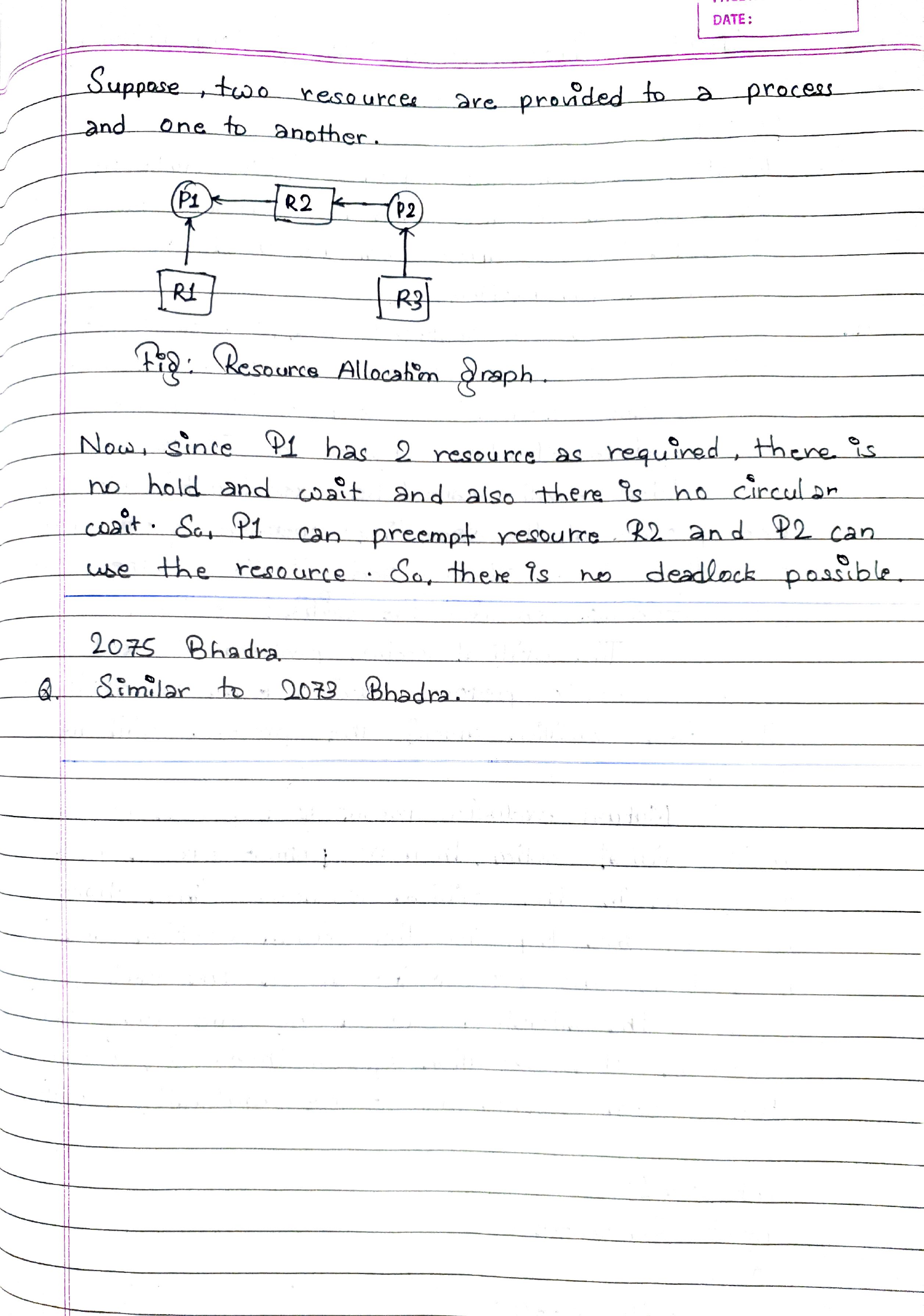
Two processes share three resources, and each needs at most two. Can the system deadlock? Explain using the deadlock conditions.
Answer
The source reviews the four conditions and illustrates assigning two resources to one process and one to the other. The first process can finish and release its resources so the second can complete; the source concludes that the illustrated system does not deadlock.
The source uses the word “preempt” in its explanation of resources becoming available after completion. The drawing and original wording remain unchanged below.
5 Minutes Engineering · 10:01
5 Minutes Engineering · 7:20
Related tutorials on safety calculations for the referenced question. The source supplies no separate statement or solution.
10. Repeated safety question — 2075 Bhadra
Repeated safety question — 2075 Bhadra.
Answer
The handwritten entry says the question is similar to 2073 Bhadra. See Question 7. A separate statement and worked solution are not supplied.
More videos from this chapter’s playlist
These playlist videos do not have a direct match among the questions above.
- Introduction to Deadlock || Coffman Conditions || Operating System || By - Ankit Jain ↗Miracle Education · 8:47