Chapter 01 · Watch, then practise
Introduction to Microprocessor
Watch the related lecture, then read the question and answer below.
8 questions · 11 playlist videos. Matches are based on video titles; broader background matches are labeled.
Watch the full playlist ↓Chapter playlist
Introduction to Microprocessor
Introduction to Microprocessors | Bharat Acharya Education
Bharat Acharya Education · 1:26:30
Choose a video · 4 lectures
Title-based matches: introduction and the history of CPU processing power. The history videos provide broader background.
1. Microprocessor elements and history
What do you mean by microprocessor? Describe the element of microprocessor. Write in brief the about history of microprocessor.
Answer
A microprocessor is a multipurpose, programmable clock driven and register based electronic device, that reads binary instructions form a storage device called memory and provides results as output. It is a single silicon chip which is made by LSI, VLSI, ELSI technology.
The elements of microprocessor are
i) Arithmetic/Logic Unit
ii) Register Array
iii) Control Unit.

Register Array
This area of the microprocessor consists of various registers identified by letters B, C, D, E, H and L. These registers are primarily used to store data temporarily during the execution of program and are accessible to users through instructions.
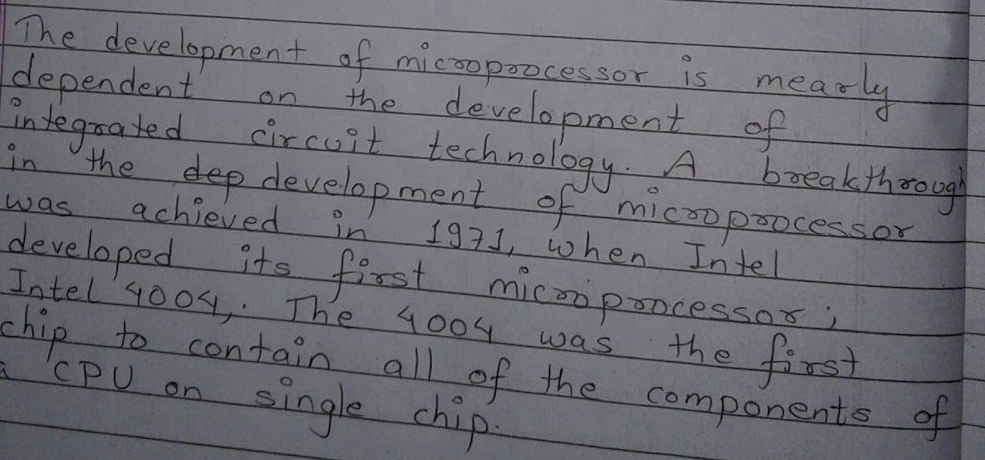
The next major step in the evolution of the microprocessors was the introduction of the Intel 8008 in 1972. It was the first 8 bit microprocessor designed for terminals
In 1974, Intel 8080 was designed to be the CPU of a general purpose 8 bit micro-computer. In 1976, Intel 8085 was 8 bit microprocessor appeared and in 1978 Intel 8086, 16 bit microprocessor came out with 1MB of memory capacity.
Further, Intel 80286 have addressing memory of 16 MB instead of a just 1MB. Intel 80386 was Intel's first 32 bit microprocessor. The 80486 introduces the use of much more sophisticated and powerful ch cache technology and sophisticated instruction pipelining.
With Pentinum, Intel introduced the use of superscalar techniques which allow multiple instructions to execute in parallel.
Lecture 02 Microprocessor Based system with Bus Architecture in Hindi
Quick Learn · 7:26
Choose a video · 2 lectures
Title-based matches: microprocessor-based systems and bus organization.
2. Microprocessor based system
Define microprocess based system. Explain the various components of a microprocessor based system including the bus structure
Answer
The system that includes three components microprocessor, I/O (input/output) and memory, is microprocessor based system. These components are organized around a common communication path called a bus.
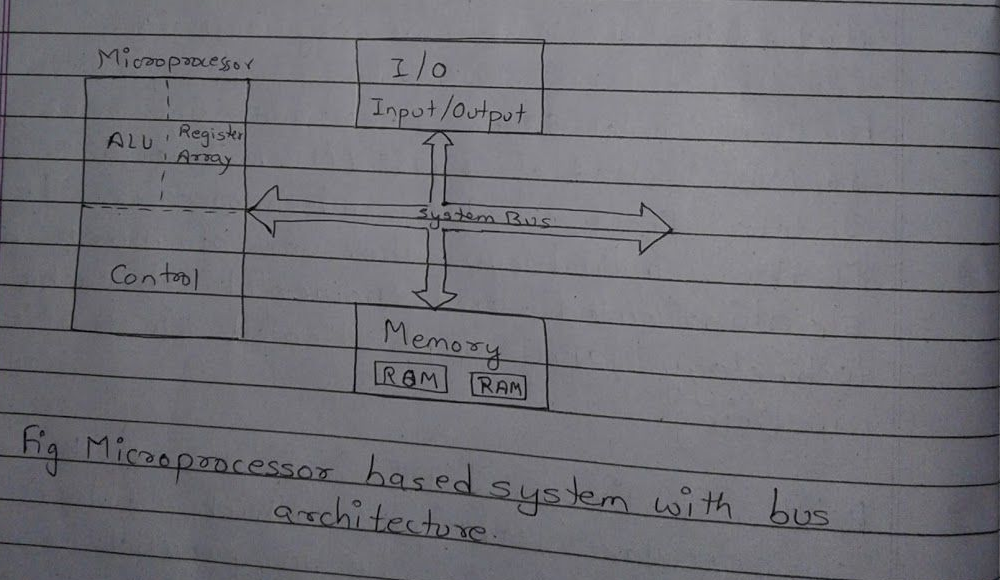
Microprocessor
A microprocessor is a clock-driven semiconductor device consisting of electronic logic circuits manufactured by using either a LSI or VLSI technique. It is divided into three segments,
ALU (Arithmetic/Logic Unit)
This is the area of the microprocessor where various computations are performed on data.
Register Array
The area of the microprocess that are primarily used to store data temporarily during the execution of a program and are accessible to the user through instructions.
Control Unit
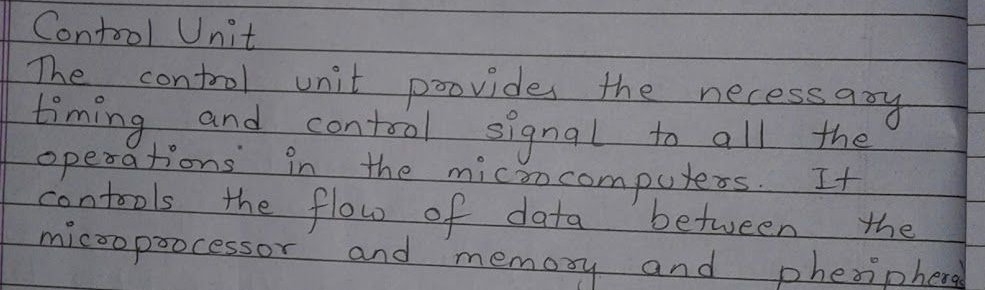
The control unit provides the necessary timing and control signals to all the operations in the microcomputers. It controls the flow of data between the microprocessor and memory and peripherals.
Memory
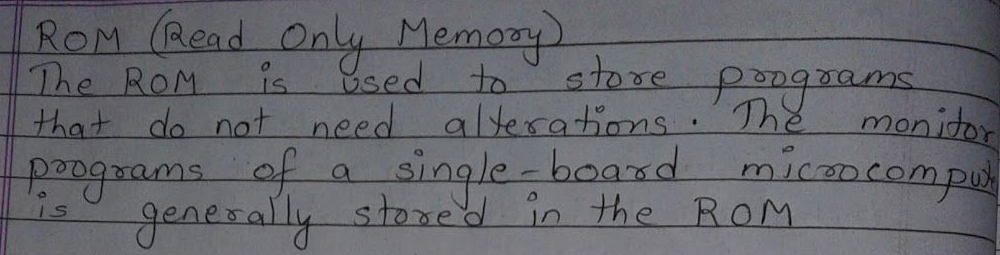
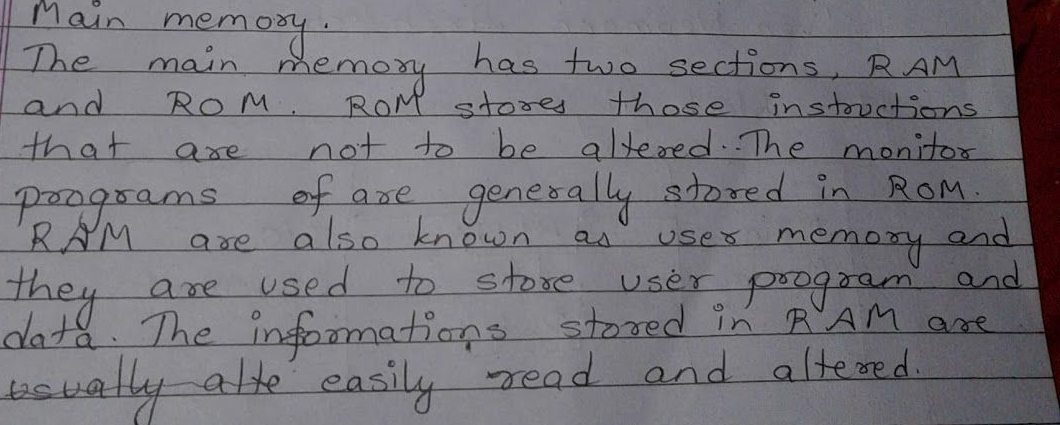
Memory stores the binary information as instruction and data and provides the information to the microprocessor whenever necessary. It has two sections RAM and ROM
RAM (Random Access Memory)
Also called Read/Write Memory. It is called as user's memory. It is used to store user programs and data. In single-board microprocessor, the monitor programs monitors the Hex keys and stores those instructions and data in the R/W memory.
I/O (Input/Output)
The third component of microprocessor based system is I/O. I/O includes two types of devices : input and output.
System Bus
The system bus is a communication path between microprocessor and ph peripherals.
Introduction to Microprocessors | Bharat Acharya Education
Bharat Acharya Education · 1:26:30
Choose a video · 2 lectures
Broader background, matched by title: microprocessor introduction and system organization. No playlist title explicitly covers the microcontroller comparison.
3. Microprocessor and Microcontrollers
Differentiate between Microprocessor and Microcontrollers. Explain how the microprocessor is organized in microprocessor based system.
Answer
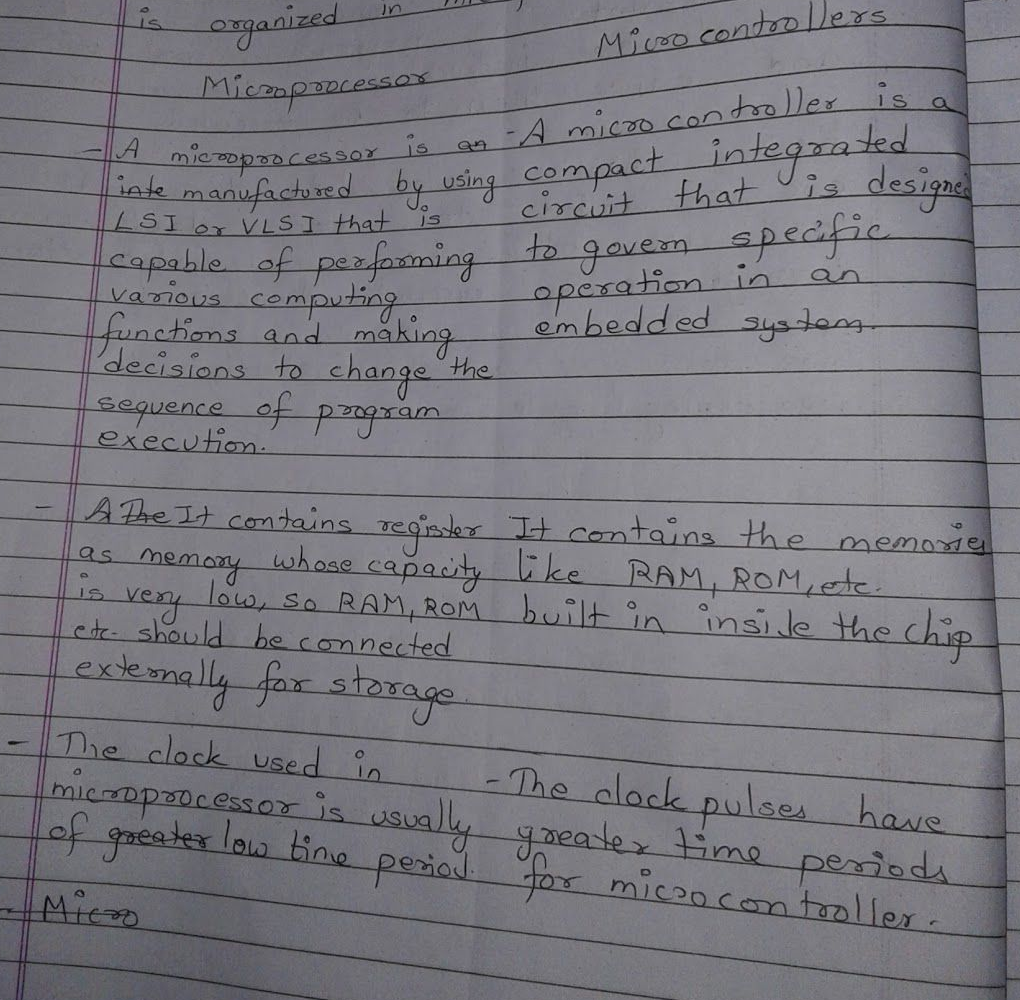
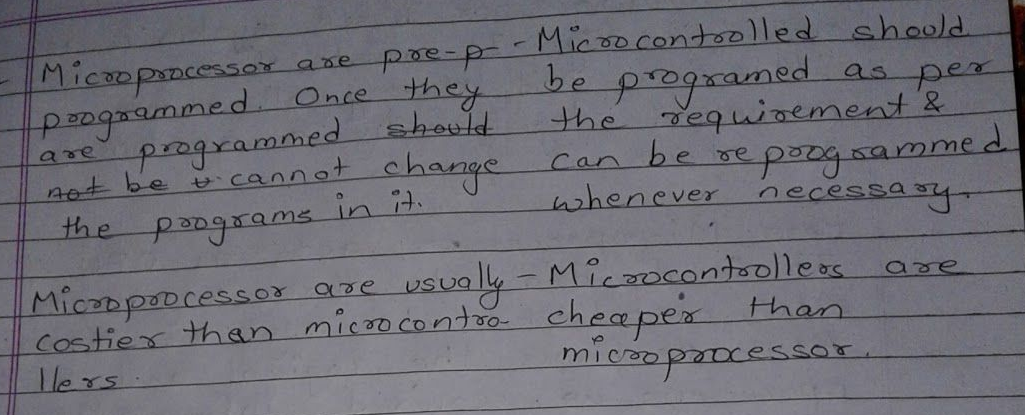
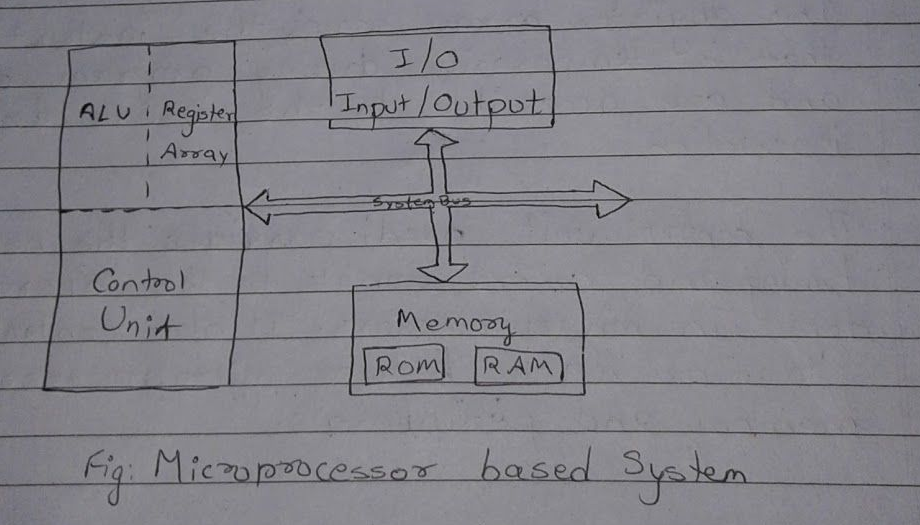
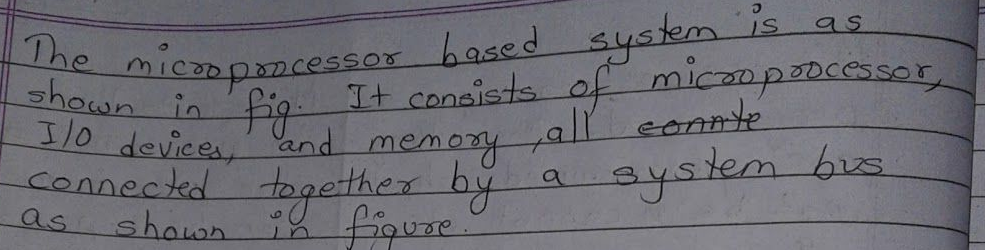
Here Microprocessor acts as CPU. It is divided into three segments ALU, control Unit and register. Here ALU performs the logical and arithmetic operations as required informations given form I/O devices
The register array stores the instructions that is temporarily during program execution and are accessible to the users during instruction.
The control unit prodi provides the necessary timing and control signals to the operations done in microprocessors. It also controls the flow of data betwee microprocessor and memory and peripherals.
Bus Organization main
Microprocessor Electronics · 3:01
Choose a video · 2 lectures
Title-based matches: bus organization and system bus architecture.
4. System bus
What is a system bus? Explain in detail the necessary diagram. Also compare 8085 and 8086 microprocessor system bus.
Answer
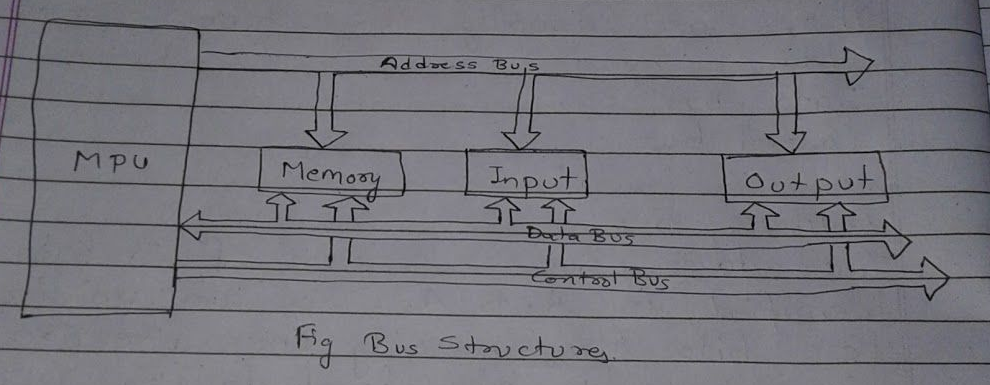
A system bus is a communication path between the microprocessor and peripherals; it is They are group of wires used to carry bits.
There are usually three types of bus
Address bus
Data bus
Control bus.
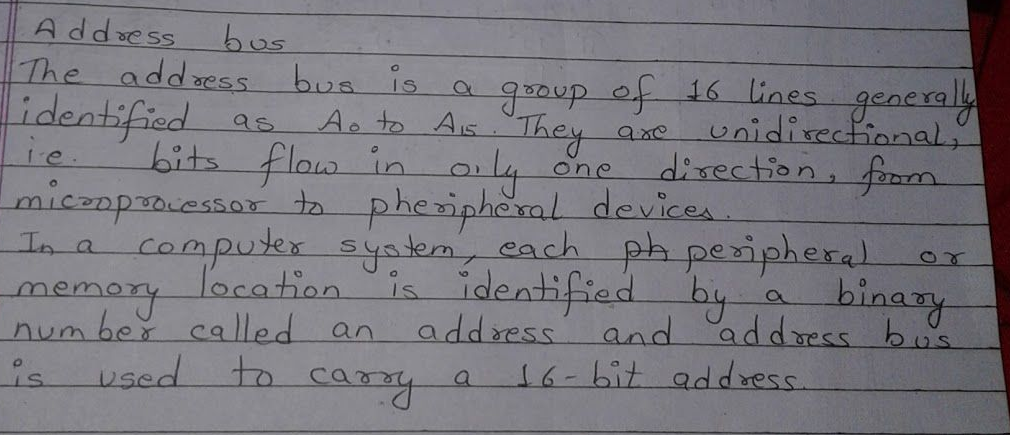

microprocessor and peripherals and memory. The MPU uses data bus to transfer binary informations.
Control Bus
The control bus is composed of various single lines that carry synchronization signals. These bus provide timing signals.
The Von Neumann Architecture
Engineers Minute · 2:27
Choose a video · 2 lectures
Title-based matches: the Von Neumann architecture and basic CPU structure.
5. Computer block diagram and stored program concept
Draw and explain the block diagram of a computer. Explain stored program concept.
Answer
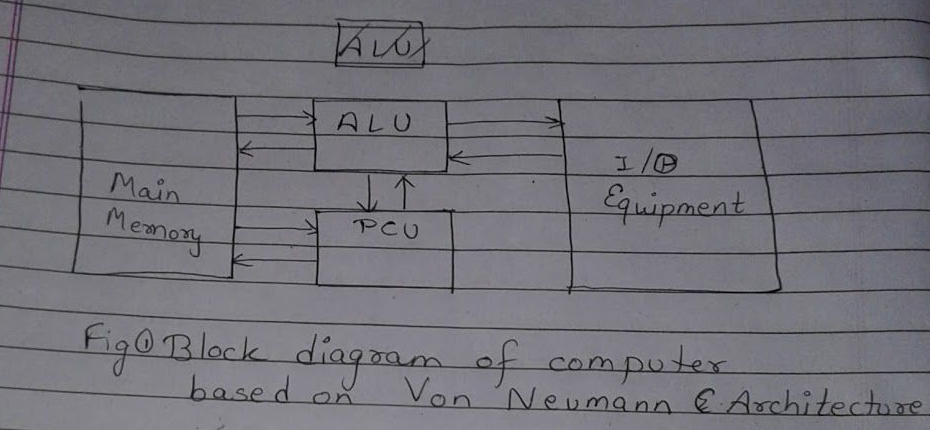
I/O Equipment
These consists of various input and output devices through which we can enter various data through input devices and obtain the output and informations through output devices.
ALU (Arithmetic Logic Unit)
All the arithmetic and logical operation in order to convert the data and instructions to the required informations are done in this unit.
PCU- Program Control Unit
This program control unit provides the necessary timing and control signals to all the operations in the m computer. It controls the data flow between microprocessor and I/O devices and the memory.
Stored program Concept.
The programming process could be facilitated if the program could be represented in a form suitable for storing in memory alongside the data. Then a computer could get its instructions by reading them form the memory and a program could be set or altered by setting the values of a portion of memory. This approach is known as "stored program concept". This concept was first adopted by John Von Neumann and hence the architecture of computer was called as 'Von Neumann Architecture'.
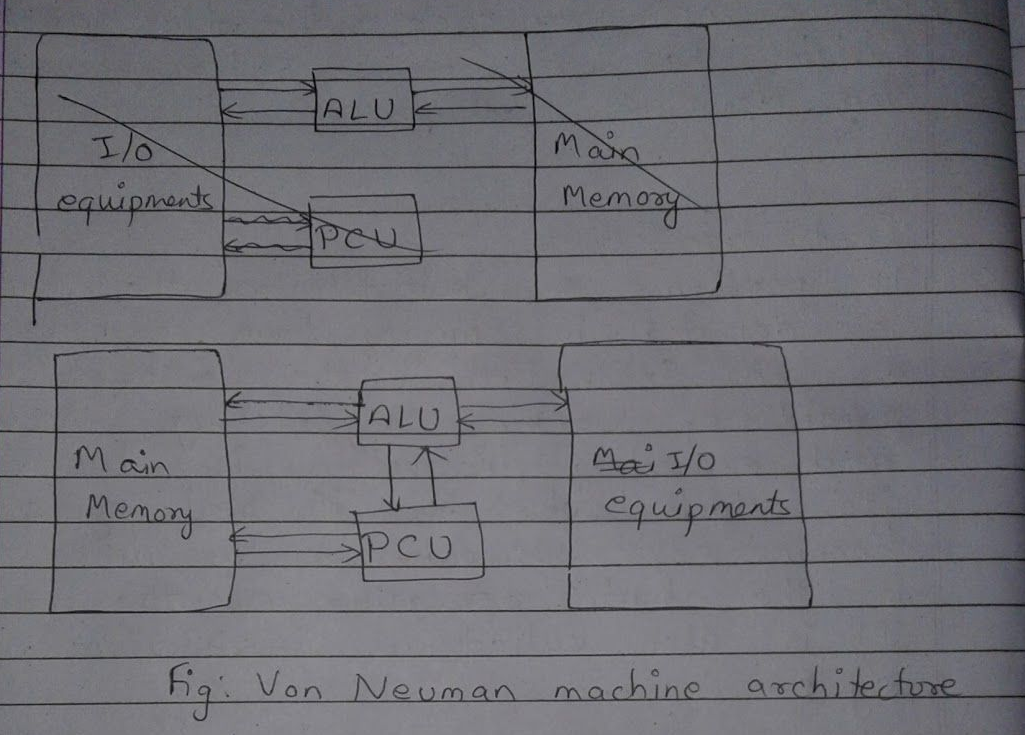
Its block diagram is,
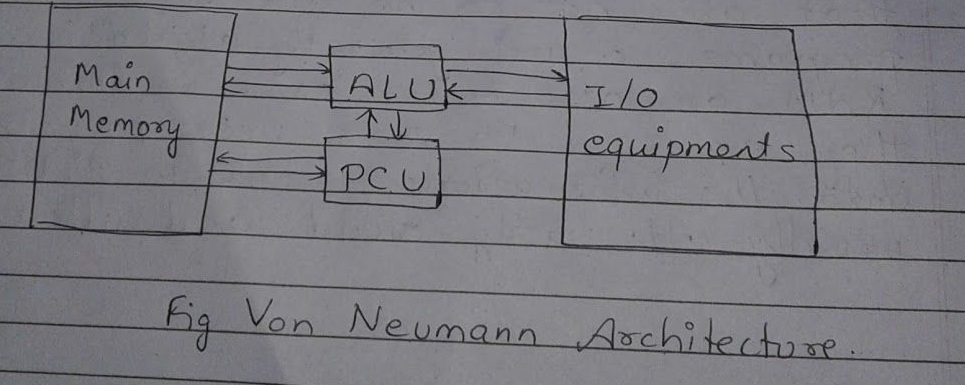
The main memory is used to store both data and instructions. The arithmetic logic unit is capable of performing arithmetic and logical operations on binary data. The program control unit, interprets instructions in memory and causes them to be executed. The I/O unit gets executed form the control unit.
The control unit operates the computer by fetching instructions from memory and executing them one at a time. The storage location of the control unit and ALU are called registers.
The Von Neumann Architecture
Engineers Minute · 2:27
Choose a video · 2 lectures
Title-based matches: Von Neumann architecture and CPU structure.
6. Stored program concept
Define stored program concept. Von Neumann machine principle is the pioneer of the now days digital computer. Justify the above statement.
Answer
The programming process could be facilitated if the program could be represented in a form suitable for storing in memory alongside the data. Then a computer could get its instructions by reading them from memory and a program could be set or altered by setting the values of a portion of memory. This approach is known as stored program concept.
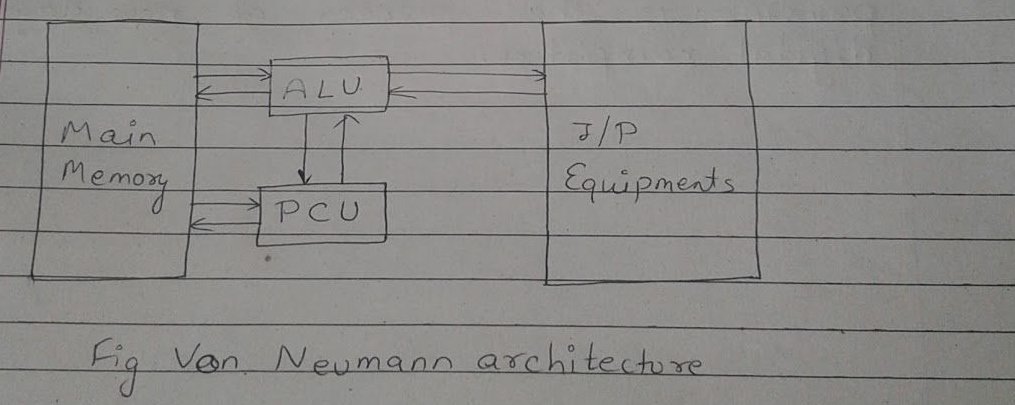
In Von Neumann architecture, is as shown in fig above. There is a main memory
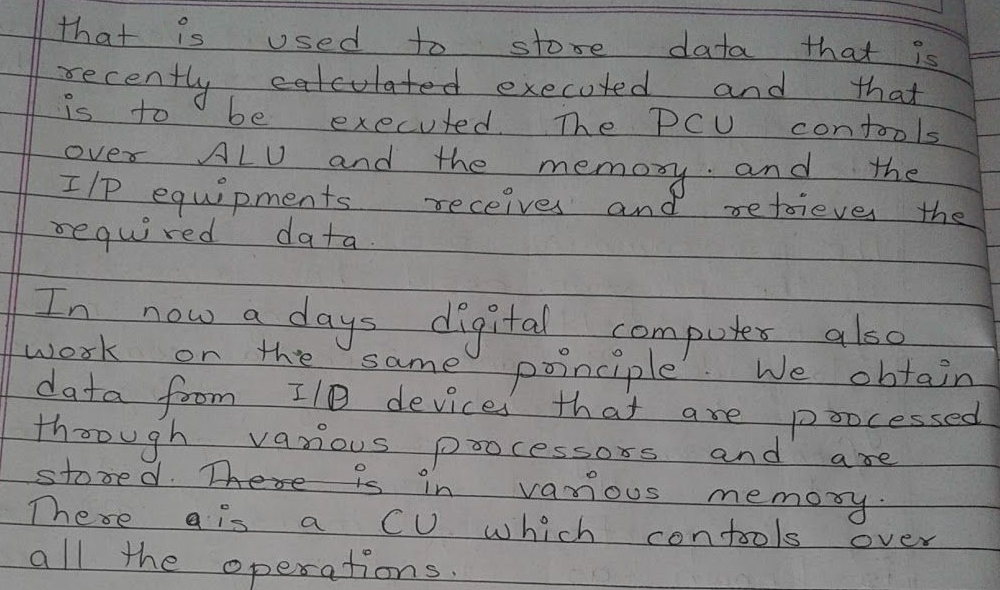
So we can say that Von-Neumann principle is the pioneer of now days digital computers.
The Von Neumann Architecture
Engineers Minute · 2:27
Choose a video · 2 lectures
Title-based matches: Von Neumann and Harvard architectures. These are background lectures for the 8085-specific part.
7. Von Neumann and Harvard machines
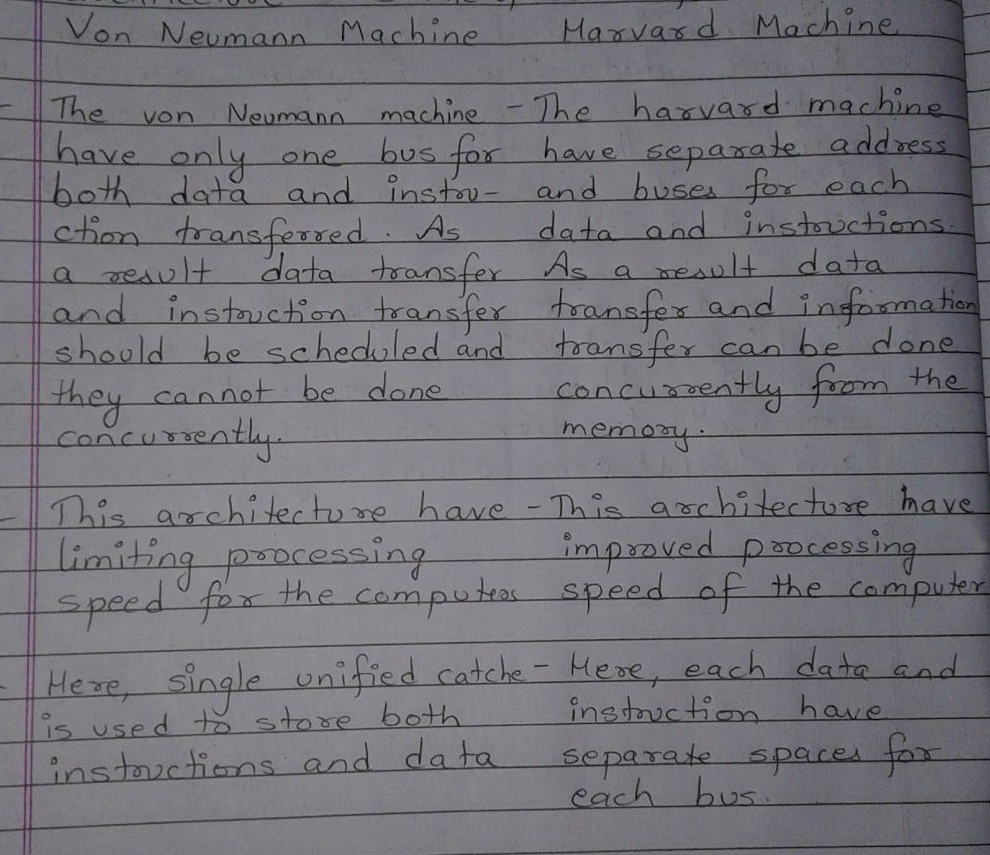
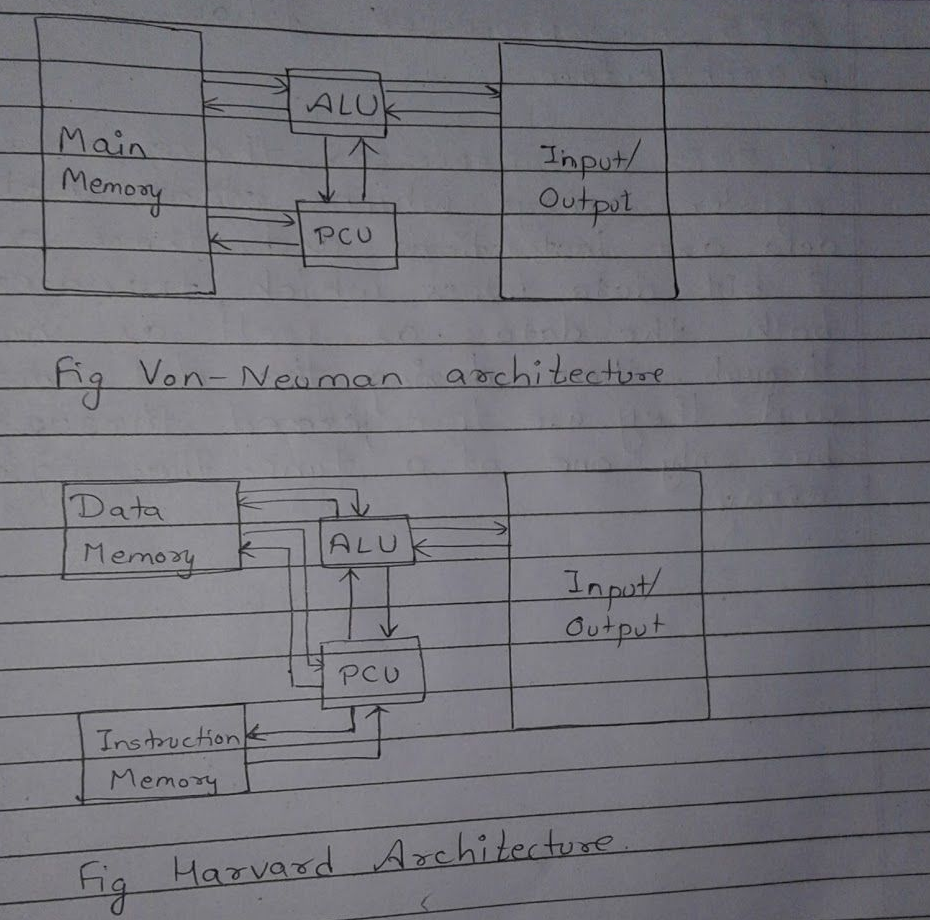
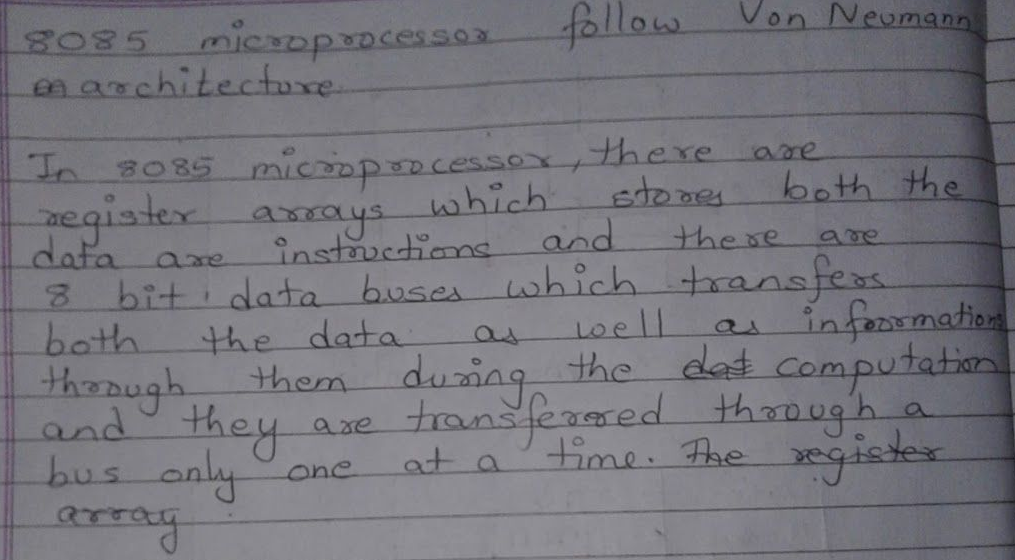
Difference between Von Neumann Machine and Harvard machines. Explain which architecture 8085 microprocessor follows & how
Answer
The Von Neumann Architecture
Engineers Minute · 2:27
Choose a video · 2 lectures
Broader background, matched by title: Von Neumann architecture and CPU structure. No playlist title explicitly covers instruction and machine cycles.
8. Instruction cycle and machine cycle
Define instruction cycle and machine cycle. Explain the instruction processing cycle of Von Neumann machine.
Answer
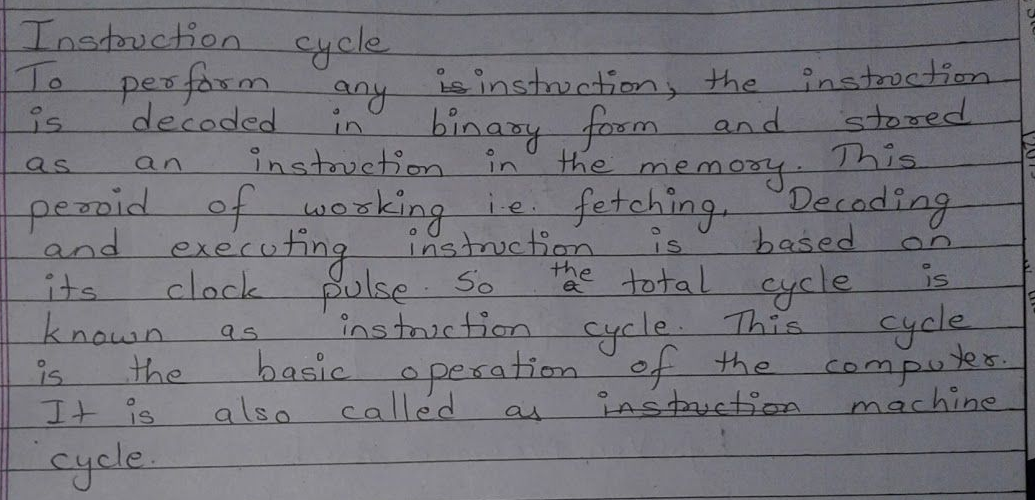
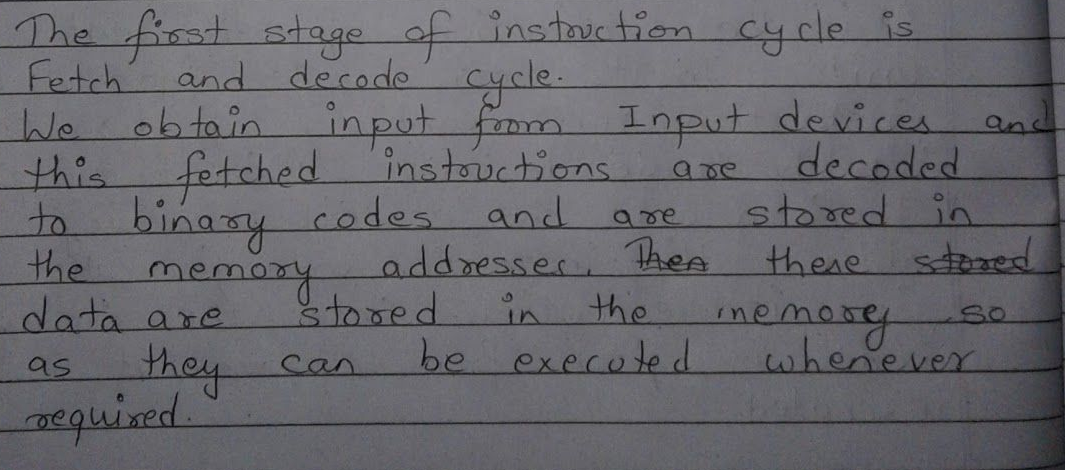
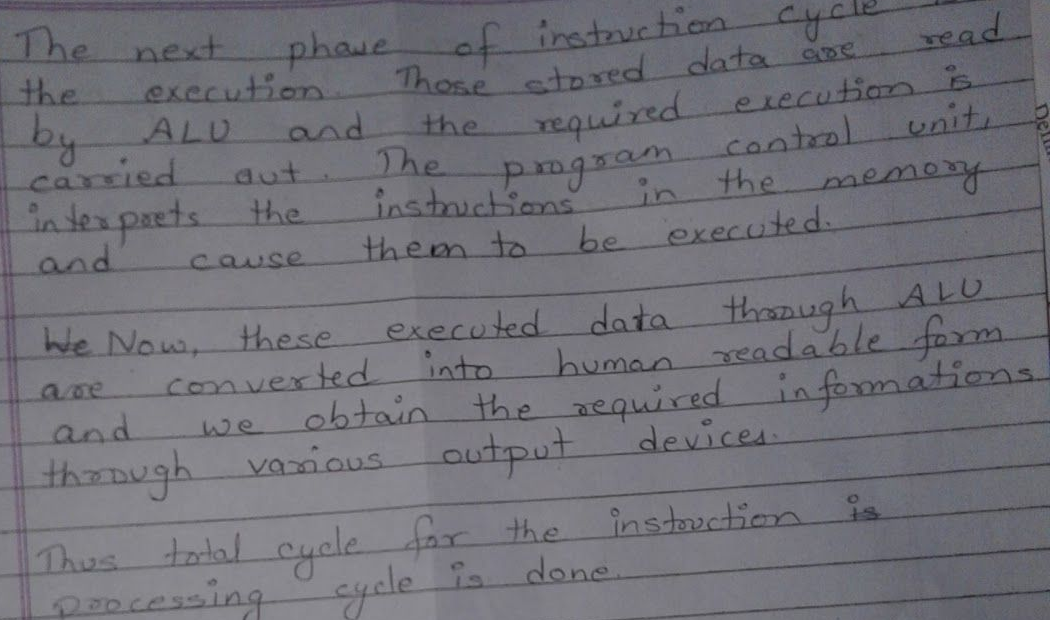
It is the combination of different smaller units. In its most simplest form, the instruction cycle consists of two cycles
i) Fetch or decode cycle
(ii) Execute cycle.
In fetch cycle, the central processing unit obtains the instruction code from the memory for its execution. Once the instruction code is fetch from memory, it is then executed.
More videos from this chapter’s playlist
These playlist videos do not have a direct match among the questions above.
Hardwired CU vs Micro-programmed CU | COA | Computer Organization and Architecture Lecture
Last moment tuitions · 11:16
Choose a video · 2 lectures